

Resilience In School
vs. despair
Recovering from adversity
To practice Resilience, I will: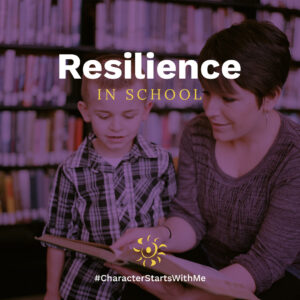
- adapt to adverse conditions
- seek out support and build relationships
- find meaning in all I do
- see failure as a temporary setback
- build on my experiences

Resiliency for All Students
By Sandra Szczygiel, MS, LPCC-S
Resiliency refers to an individual’s ability to adapt to challenges, overcome setbacks, and cope with adversity. In the classroom, fostering resiliency is essential for helping students effectively deal with academic challenges as well as social/personal struggles. Encouraging resiliency in the classroom benefits students in several ways:
- Improved academic performance
- Enhanced emotional well-being
- Increased positive social interactions
- Preparation for the challenges of life
Some strategies teachers can use to promote resilience in all students:
1. Emphasize growth.
2. Instill in all students that hard work can increase skills, abilities, and knowledge.
3. Emphasize effort over innate talent.
4. Reward improvement as much as achievement.
5. Model resilient behavior.
6. Share personal experiences of overcoming challenges.
7. Create a supportive environment where mistakes are viewed as learning opportunities and where students feel safe to take risks and ask for help.
8. Teach problem-solving skills.
9. Coach emotional regulation. The goal is to give every student the opportunity to thrive.
10. Teach goal-setting and self-assessment.
11. Build strong relationships.
It is important that resiliency is nurtured in all students, regardless of level of intelligence, socioeconomic background, or exposure to trauma. The goal is to give every student the opportunity to thrive. By encouraging resilience, educators can empower students to build the confidence needed to succeed in life.
The Links below will take you to Resources you can use in the classroom or in homeschool
to teach the Character Quality of Resilience.
Need to build community in your classroom? Try these team building activities!
The Longest Sentence
Divide the group into groups of 3 or 4 but have an even number of groups. A scribe is appointed in each group. Give them a sentence starter such as “The purring kitten...”. Each group must create a sentence with the goal being the group who creates the longest...
Our other Pillars have resources that can be used in an educational setting or for education professionals.

Visit Resilience in Business>>
Teambuilding
Power Up with Character
Interview Questions
Adult Business Books

Visit Resilience in the Community>>
Quotes
Character All Month Calendar
Related Qualities
Character Holiday Activities
Family Activity (with a printable for sending home to parents)

Visit Resilience in Faith>>
Christian Family Activity
Bible Verses
Christian Poster
Prayer and Reflections
Archived Resources